
Press release | RESAC-OFF: The new technology to reduce fatalities by drowning at beaches
 22-07-2025
Tekniker
22-07-2025
Tekniker
The Tekniker technology centre has developed an automatic AI real-time sensor system to detect bathers. The solution, installed in a device, can also identify active undertow currents.
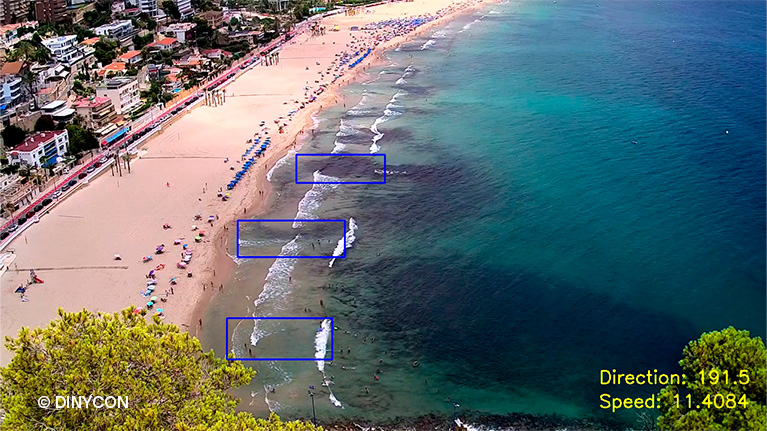
Recent figures related to fatalities caused by drowning in Spain are alarming. In 2024, 741 cases were reported, 51.8% of them involving beaches. It was the second worst figure of the last decade and, compared to 2023, was 11.6% higher.
Eleven people drowned in the Basque Country. Although this figure has slightly improved, the situation is still alarming, especially when most of these fatalities occur at beaches where a large number of people gather and where sea conditions are constantly changing.
It is in this context that the Tekniker technology centre, a member of the Basque Research and Technology Alliance (BRTA), has made available its technological expertise to the RESAC-OFF project funded by the Basque Government’s HAZITEK programme. Under the leadership of Dinycon Sistemas, the initiative has developed a system based on AI to improve coastal safety.
Most of the drowning prevention strategies implemented to date are based on weather and oceanographic forecasts or the presence of lifeguards and have no automated visual supervision or specific detection capabilities to deal with real environmental conditions at beaches properly.
RESAC-OFF, however, provides an AI alternative that performs a real-time analysis of images captured by cameras, identifies active undertow currents and the presence of bathers to trigger automatic alerts for their protection.
Aitor Gutiérrez, a Tekniker researcher, says that “for instance, compared to systems that use data supplied by buoys or radars, ours provides real-time direct vision to show where the hazard is located within a bathing zone. It can also be fully adapted to many different types of beaches at any point in time. Consequently, this does not only offer major operational advantages but also provides monitoring tools for lifeguards”.
Detection under adverse conditions
Tekniker has played a key role within the framework of this project by leading all the design work, by providing training and validating the AI models that support the solution.
The technology centre’s team took on the responsibility of developing a real-time automatic bather detection system regardless of how adverse conditions may be with regard to visibility, waves or lighting by applying AI and deep learning techniques.
Tekniker has also addressed another differential element associated with this new technology, i.e., the possibility of setting up the system at beaches where there is no complex digital infrastructure available to avoid depending on the degree of cloudiness or constant connectivity. This standalone, energy-efficient and easy-to-maintain architecture can be installed at small, isolated or unsupervised beaches that until now were beyond the scope of conventional technological systems.
Finally, thanks to the system’s modular design and to the fact that it can be set up to meet the requirements of different types of coastal environments, it has been rated as an innovative, viable and scalable alternative that reaches beyond theoretical models and is focused on reducing deaths by drowning in a tangible manner.
The Tekniker expert also says that “our technological development ensures that all the information detected is immediately fed into viewing, warning or decision- making solutions deployed by town councils or emergency services”.
All in all, and thanks to the technology centre’s efforts, the RESAC-OFF system can operate in a fully autonomous and scalable mode and provide a coastal safety solution that is realistic, efficient and reliable.
Visual50 and Greenresults have also collaborated with Tekniker in in the project. Institutional support has been provided by SPRI, the Basque Agency for Business Development.